

We’re excited to announce that Bluetooth support is now available in Open Beta for all Golioth users. With this release, Golioth now brings full device management and data routing to Bluetooth-based devices, even those without direct internet access. Developers can now stream telemetry, perform OTA firmware updates, manage settings, and log events using the same Golioth services they already use for devices with a direct internet access.
Previously available in private access, Bluetooth support is now open to all users as a part of a broader initiative we call Golioth Connectivity. This enables a flexible and unified approach to connecting devices to the cloud, whether directly via Wi-Fi, Ethernet, or Cellular, or indirectly through a local gateway.
As part of this release, Bluetooth Low Energy (BLE) devices can now connect to the Golioth platform securely through a gateway. These BLE devices, which often lack native internet connectivity, are now able to stream data, receive firmware updates, and be fully managed through the Golioth Console.
To power this experience, developers use Pouch, an open source SDK for building firmware that communicates over protocols like BLE without a direct internet connection. Pouch provides an efficient, encrypted, and authenticated communication layer between BLE devices and the cloud, enabling seamless integration with Golioth services.
While this open beta focuses on BLE, Pouch is designed to be extensible and will soon support additional protocols such as LoRa, CAN & Modbus. This paves the way for broader support of gateway-based communication strategies across diverse IoT deployments.
With these capabilities, Golioth extends full cloud control to BLE devices, streamlining deployment and operations for devices that typically lack direct cloud integration. Developers can now manage, update, and monitor BLE-based device fleets with the same ease and infrastructure used for other connected hardware. This also extends all of Golioth’s AI capabilities to unlock new Edge and Physical AI use cases.
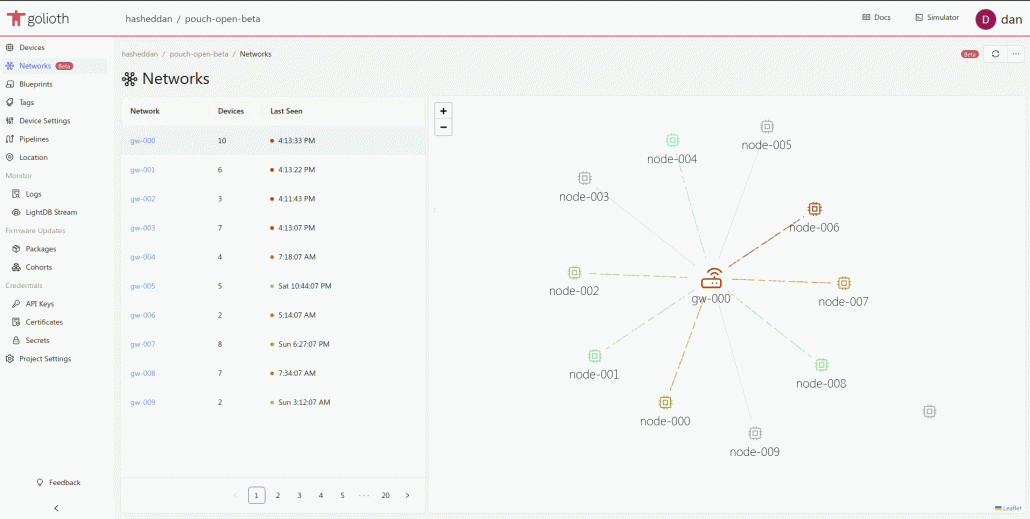
Gateways
To help developers get started quickly, Golioth provides reference implementations that use popular development boards configured as BLE gateways. These reference gateways include both pre-compiled binaries and fully open source firmware, available on GitHub.
- NXP FRDM-RW612
- Nordic Semiconductor Thingy:91 X
- Nordic Semiconductor nRF9160DK
These boards offer a fast path for evaluating BLE gateway functionality and provide a foundation for building custom gateway implementations.
In addition to reference hardware, Golioth is partnering with leading providers to offer off-the-shelf BLE gateways that are pre-validated to work with Golioth Connectivity, including Ezurio, Arduino, Globalscale Technologies, Minew & Device Solutions.
These ready-made options give teams the flexibility to align their gateway choice with their product architecture and deployment needs. At the same time, they allow developers to focus on building their Bluetooth-based product rather than reinventing the wheel by creating gateway infrastructure from scratch.
Our users can build upon the Reference Implementation in the bluetooth_gateway repository and create their own production-grade gateway. Golioth’s in-house prototyping platform the Aludel Elixir will be a showcase of how to do that on custom hardware.
Building a Bluetooth device
We have shown over the past few month a range of different development kits working as nodes with our Bluetooth support (then called Bluetooth-to-Cloud). This includes hardware from Espressif, Nordic Semiconductor, NXP, Renesas, Silicon Labs & STMicroelectronics. Each of those links are forum posts that will track any required changes to get various development boards working, and offer a place to discuss issues getting hardware booted up on Golioth.
We have ongoing reference hardware and implementations that will grace the pages of this blog, such as the recently announced Tikk add-on board.
Pricing
During the open beta, users can add unlimited BLE devices at no extra cost. This is a great time to test BLE deployments and explore Golioth Connectivity without device-based fees.
Standard platform and service usage fees still apply. See the pricing page for details.
Once Golioth Connectivity reaches General Availability, pricing will apply to BLE devices that use an advanced feature of Bluetooth Connectivity that allows devices to seamlessly utilize multiple gateways for better coverage. We call this feature “roaming.” After GA, the rate for devices that roam is $0.50 per device, with volume discounts available for larger deployments.
Get started today
If you’re ready to explore Bluetooth support with Golioth Connectivity, there are several ways to dive in:
- Review the Golioth Connectivity documentation for detailed technical guides and integration patterns
- Try out our reference gateway firmware to quickly stand up a BLE gateway integration
- Choose from a supported board to begin prototyping
- Browse the docs
- Explore one of the sample projects
As you get started with managing BLE devices during our open beta, we’d love to hear from you. Your feedback is critical as we refine the experience and work toward general availability. Join the conversation and share your questions, comments, or suggestions in the Golioth Forum. Your input directly helps shape the future of Golioth Connectivity.
No comments yet! Start the discussion at forum.golioth.io